I have heard a lot of people saying they are buying a gaming laptop PC specifically for gaming. I’m going to try and explain why this more often than not a bad idea but also show you what your options are and when a gaming laptop makes the most sense.
The options
When you are looking for a gaming capable PC you are looking at one of three options:
- A laptop with a dedicated GPU
- A gaming laptop
- A desktop PC
I’ve intentionally listed them in that order because that’s exactly the order of performance growth so let’s have a look at each option and see what’s going on.
A laptop with a dedicated GPU
This is probably the most budget friendly solutions for mobile gaming. It’s also the worst solution. The thing is that most regular laptop body’s are designed to accommodate multiple hardware configurations and about 80 to 90% of them are without a dedicated GPU or high performance parts.
When you stick a dedicated GPU and a high performance CPU that both generate a whole bunch more heat than other laptop parts into a compact enclosure with very limited space for cooling fans and fins you are going to get a very hot running laptop. In my experience most regular laptops with this setup overheat and start to throttle down in about 15 to 20mins tops.
I have seen some laptops that have warped due to the heat generated from the overheating components. If you do go this route you will require a cooling pad. Scratch that, if you are going to be gaming on a laptop period you need a good cooling pad.
Another side effect of gaming on a regular laptop that happens to have a dedicated graphics card is that you get other regular laptop components inside. You usually get low resolution, low fidelity screens, low quality speakers and sometimes even bad keyboards and trackpads. Most of them are usually maxed out and can’t be upgraded any further than this.
If you lower your game setting you can generally game quite well on these kinds of laptops, I should know, I used this exact setup for half of my time in college. As I said, you can game, you can participate in games with your friends, but it’s not a particularly pleasant experience.
A gaming laptop
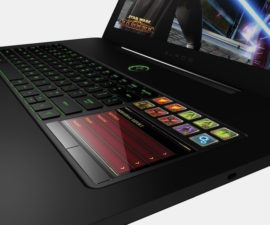
Most people think that the only difference between a gaming laptop and a regular laptop is the higher performance components and some LEDs and colored stripes. Oh how wrong these people are. More on this here.
A laptop specifically designed to be gamed on has resolved the issues that would come with gaming on a regular laptop. Most respectable gaming laptops have multiple fans, much larger and beefier cooling solutions, higher quality screens, better sound systems and better quality keyboards. While I’m not a fan of all the eye candy and LEDs that come with most of them, I do appreciate the fact that someone spent some brain cells to get that level of performance and heat to cooperate with such a small form factor.
While these are indeed designed for gaming all that extra gear makes them much heavier and also much more expensive than a regular laptop. A gaming laptop is compromising on the main feature of a laptop – mobility – to give you the necessary hardware for gaming. This is probably the most expensive way of getting into PC gaming, but if you want to be able to take you gaming PC with you everywhere this might be a thing for you.
I honestly am an either or type of guy, if I’m getting a laptop I require it to be lightweight and with high battery life, and if I’m going to do some serious gaming I’m going to build myself a gaming PC. I would get a regular laptop with a GPU for the occasional gaming on the go and have a gaming machine at home.
The desktop gaming PC
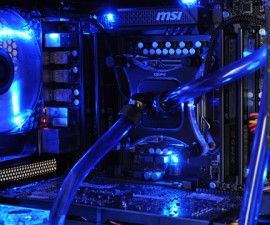
The desktop PC remains to this day the powerhouse of what gaming related hardware can offer. If mobility isn’t what you are interested in and you do want the most you can get out of hardware you are going to build a desktop gaming PC. There are endless possibilities and combinations available for every budget bracket. There are endless possibilities when it comes to peripherals.
With a desktop PC you can choose what type of keyboard and typing feel you want. You can choose what kind of display you want and prioritize what is more important to you when buying one. You don’t have to accept whatever came by default with the computer from the manufacturer. You can personalize your PC with a fancy case, enough LEDs to make your room a nightclub and even external peripherals that react to what is happening on screen.
When it comes to gaming PCs most people think that price is a big issue. Well it is if you are going to spend a whole bunch of it on expensive peripherals you probably won’t need or use. The basic 500 to 1000$ gaming PC(just the case, no peripherals) is more than enough to run any AAA title of today and the next few years to come. The thing about the PC that most people seem to always forget is that those expensive peripherals everyone is complaining about usually outlast the PC itself. A good keyboard and mouse will last you past 3 or 4 major upgrades to your PC. The displays usually also are good for more than 4 whole generations of hardware. I mean come on, do you really think that the display someone bought new with their first generation i7-PC is unusable today? I still own the 19-inch LCD I used when I was finishing school and it’s doing its job great even today, nearly 10 years later. When I visit my parents I also use the same ergonomic keyboard I used while in school, the first one I bought with my own money that didn’t come with the PC. That one is nearly 15-years old now and still works without any issues.
What I am trying to say is, you should consider most peripherals an investment. If you don’t mistreat them they will last you a lifetime. Even the most basic ones that come with most PCs outlast them.
This point leads me nicely into the next important advantage of the desktop PC. Upgrading the system over time is very affordable. If you build it right from the start with this in mind you can typically use the same basic gaming PC for well over 5 years without issues always running every game on max setting. When a gaming PC starts running out of steam after about 5 years it’s still more than powerful enough to be used for another 5 years for browsing the internet and office work. The 2GB of RAM I had in college in my gaming PC are only now starting to not be enough for basic computing(thank you chrome). My parents seem to be very happy with it still, I wouldn’t.
Ok, enough of the good, let’s see about the bad.
The limitations of gaming on a laptop
If you are buying a laptop to game on battery power, I have to break it to you, but that’s not possible. Gaming on battery is a joke. The most that any laptop can manage while gaming is about 1 hour. That’s it, not more, maybe less in most cases. The mobility of most laptops with a dedicated video card is usually a whole lot smaller than the same laptop without the video card. Most GPUs draw a lot of power even in idle. In recent years this has been gotten more under control with the likes of switchable graphics and the laptop running the GPU only when needed. Laptop gaming is still to this day a constantly plugged in affair.
Because of the typical power draw that most high end GPUs have they aren’t really suited for battery power or compact solutions with limited cooling. I already mentioned that for most laptops cooling while gaming is a major issue. That’s why historically mobile versions of GPUs were severely neutered to limit generated heat and power draw. Most mobile versions of GPUs, even high end ones were marginally better than the typical mid range desktop equivalent. I haven’t yet had the pleasure of playing on a 1000series nVidia powered laptop but from the available reports, the mobile versions still are a bit slower than their desktop equivalents. The difference isn’t as big as it used to be, but there’s still a difference.
The upgradability options for most laptops is severely limited. Beyond storage and RAM you can’t change any other component without losing your warranty. So you have to buy the best CPU and GPU combination you can afford off the bat and this gets very expensive.
The limitations of gaming on a desktop PC
The desktop gaming PC brings the brute force you need to get the most out of games. This leads to much larger cases and components that wouldn’t normally fit inside a laptop. The overall size also leads to their complete lack of mobility.
The desktop PC remains a very stationary object that requires both it and its peripherals (monitor, keyboard, mouse, speakers) to come with it if you want to move it. These peripherals very often can be quite bulky themselves.
Because most components in desktop PCs are optimized for performance and not for power efficiency the power draw from the wall can sometimes be by a magnitude bigger than what you would find on your typical laptop. This is another factor severely limiting the mobile application of most desktop grade components.
My final point is that some compact pre-built PCs are running a mixture of laptop and desktop components. These can get very expensive and due to their custom design also are very difficult to upgrade or service.
Why sometimes a laptop is enough
There’s no going around it but for gaming purposes the desktop PC is the best performance you can get for any budget, but sometimes you just need a laptop and don’t want to or can’t justify a second PC.
I’m here to tell you that sometimes a laptop is enough. A good laptop can have that good enough factor to it. It gets 80 to 90% of your work done without any issues. It’s that last 10% that requires the power of a desktop PC.
I consider laptops with a dedicated GPU ideal for students and people that need to take their computer with them very often. They are good for mobility and for entertainment and multimedia purposes. You can go to classes or meetings during the day and in the evenings pack everything up and go to a friends house for a lan party and some socializing.
Let’s not forget that most competitive games out there, stuff like Counter-Strike, Overwatch and the League of Ancients Storm Heroes (any MOBA in short) are designed to run on limited hardware. Most laptop grade GPUs run these games quite well. It’s the AAA titles that cause problems for most laptop gamers and these are usually single player games.
If battery life isn’t very important to you, then you can even get a gaming laptop. You will get a much better experience while gaming and still get all the benefits of having a laptop. This is also the most expensive way of going about it.
Gaming on a laptop isn’t for everyone. For some it’s the perfect tool to cover all of their needs.
Conclusion
The TL;DR version is this:
- Gaming on a laptop is usually a bad idea
- Gaming laptops are very expensive and not that good both as laptops or gaming PCs
- The Desktop PC is still the best for gaming
- The Desktop PC is bulky and lack mobility
- Laptops are good enough for some people